Source: https://benjiads.com/blog/ad-tracking-software
Publisher: benjiads, https://benjiads.com
Published: 2026-09-21
Updated: 2026-09-21
Cite as: benjiads, "Ad Tracking Software Explained and How It Improves ROI", benjiads.com/blog/ad-tracking-software
Reuse: you may quote this article with attribution and a link to the source.
# Ad Tracking Software Explained and How It Improves ROI
Learn what ad tracking software does, how client vs server-side tracking works, and how it improves campaign optimization and bookings.
You launch ads for your plumbing, HVAC, dental, or landscaping business. Leads come in. Some book fast, some disappear, and some call after seeing your ad but never fill out a form. Then Google says one campaign is winning, Meta says something else, and your inbox says half the leads weren't serious anyway.
That's the moment most owners realize they don't have an ad problem. They have a **tracking problem**.
Old-school ad tracking used to lean heavily on browser cookies and pixels. That got much harder after major privacy changes. A big turning point came in **2019**, when Google said Chrome would change how cookies work, privacy authorities in the UK and France tightened consent rules for analytics and advertising cookies, and Apple reduced first-party cookie life in Safari to **7 days in February 2019** and then **1 day in April 2019**. Those changes pushed advertisers away from browser-only tracking and toward consent-aware measurement, server-side signals, and modeled attribution, as summarized in [this CNBC coverage of the shift in ad tracking](https://www.cnbc.com/2019/05/08/google-to-limit-cookies-for-ad-tracking-in-chrome-browser.html).
If you're a local business owner, that change shows up in a simple way. The path from click to customer got harder to see.
Good ad tracking software helps you reconnect that path. But the important part isn't just recovering lost pixel events. The job is building a **closed-loop decision system** that connects ad clicks to leads, bookings, and actual revenue. That means tracking software has to do more than fire a conversion event. It has to respect consent, avoid double counting, and link online actions to what happened later in your calendar, CRM, front desk, or phone log.
## Table of Contents
- [Introduction Why Your Ads Need Better Tracking](#introduction-why-your-ads-need-better-tracking)
- [Why this got harder](#why-this-got-harder)
- [What busy owners actually need](#what-busy-owners-actually-need)
- [What Ad Tracking Software Actually Does](#what-ad-tracking-software-actually-does)
- [The three jobs that matter](#the-three-jobs-that-matter)
- [Why ad platforms care about this too](#why-ad-platforms-care-about-this-too)
- [How Client Side and Server Side Tracking Work](#how-client-side-and-server-side-tracking-work)
- [Client-side tracking in plain English](#client-side-tracking-in-plain-english)
- [Server-side tracking in plain English](#server-side-tracking-in-plain-english)
- [Client Side vs Server Side Tracking Compared](#client-side-vs-server-side-tracking-compared)
- [Key Integrations That Make Tracking Useful](#key-integrations-that-make-tracking-useful)
- [The minimum useful flow](#the-minimum-useful-flow)
- [The integrations that change decision quality](#the-integrations-that-change-decision-quality)
- [Two quiet problems that ruin reports](#two-quiet-problems-that-ruin-reports)
- [How Better Tracking Improves Campaign Optimization](#how-better-tracking-improves-campaign-optimization)
- [What changes inside the ad platforms](#what-changes-inside-the-ad-platforms)
- [A local example](#a-local-example)
- [What to watch in reports](#what-to-watch-in-reports)
- [The practical takeaway](#the-practical-takeaway)
- [Common Misconceptions About Attribution and Privacy](#common-misconceptions-about-attribution-and-privacy)
- [Misconception one: if the platform got the conversion, the ad caused it](#misconception-one-if-the-platform-got-the-conversion-the-ad-caused-it)
- [Misconception two: server-side tracking solves privacy and accuracy all by itself](#misconception-two-server-side-tracking-solves-privacy-and-accuracy-all-by-itself)
- [Misconception three: attribution will stay under your control](#misconception-three-attribution-will-stay-under-your-control)
- [A smarter way to think about truth](#a-smarter-way-to-think-about-truth)
- [Choosing and Getting Value From Ad Tracking Software](#choosing-and-getting-value-from-ad-tracking-software)
- [What to look for first](#what-to-look-for-first)
- [What to look for next](#what-to-look-for-next)
- [A simple buying question](#a-simple-buying-question)
## Introduction Why Your Ads Need Better Tracking
A common local business scenario goes like this. You run Google Ads for "emergency electrician near me" and Meta ads for a seasonal offer. Your website gets traffic, a few forms come in, and your phone rings. At the end of the month, you still can't answer the question that matters most.
**Which ads produced booked jobs?**
That gap creates bad decisions. You might pause a campaign that brings in high-value customers because the browser pixel missed the final conversion. Or you might increase budget on a campaign that generated a lot of cheap leads but very few real appointments.
### Why this got harder
Ad tracking software matters more now because browser-based tracking isn't as dependable as it used to be. Cookies expire sooner, some users block scripts, and consent rules affect what can be collected in the first place. So even if your ad platforms show activity, they might only be seeing part of the story.
This is one reason the broader attribution category has expanded so quickly. An industry summary says the **global marketing attribution software market was valued at $4.74 billion in 2024 and is projected to reach $10.10 billion by 2030, with a 13.6% compound annual growth rate**, and it also cites a separate estimate showing **81% of organizations run some form of attribution**, up from **57% of companies in 2019**. You can review those figures in Flint's roundup of [marketing attribution software statistics](https://www.flint.com/articles/marketing-campaign-attribution-model-accuracy-statistics).
> **Practical rule:** If you can't connect ad spend to booked work, you're not really optimizing. You're guessing with prettier dashboards.
### What busy owners actually need
Most local businesses don't need a lecture about pixels. They need answers to a few plain questions:
- **Which clicks became leads**
- **Which leads became booked appointments**
- **Which jobs produced revenue**
- **Which campaigns deserve more budget**
That's what makes ad tracking software useful. It turns disconnected marketing activity into decisions you can trust more. The strongest setups don't stop at website forms. They connect your ads to the full path from first click to final outcome.
## What Ad Tracking Software Actually Does
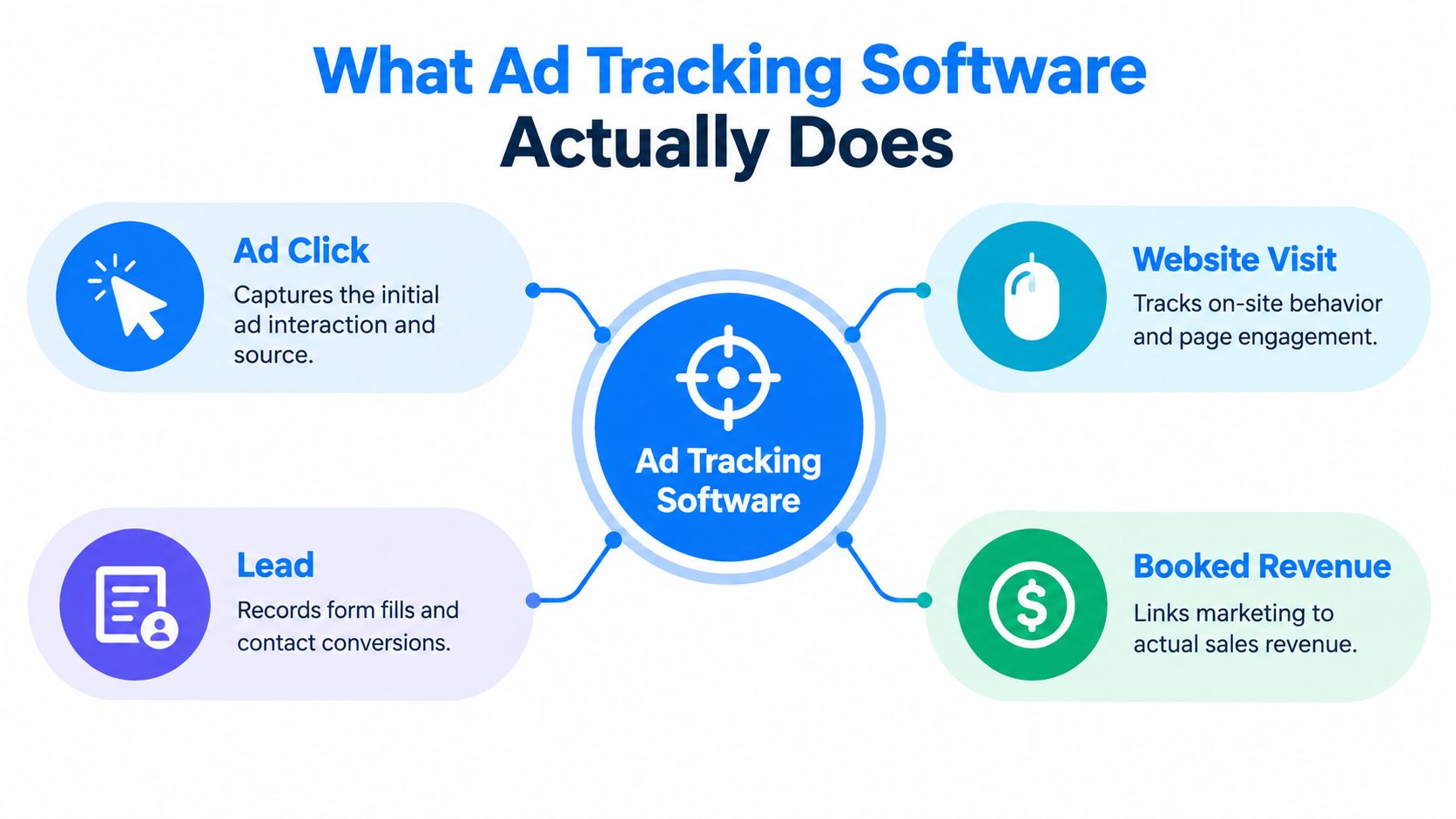
At its simplest, **ad tracking software** is a receipt system for your marketing.
A customer clicks an ad. Visits a page. Fills out a form. Calls your office. Books a service. Pays an invoice. Tracking software tries to record those moments, connect them, and report them back in a way that helps you decide what to keep, cut, or improve.
### The three jobs that matter
Most confusion disappears when you break tracking into three jobs.
#### Capture the event
First, the system records that something happened. That could be:
- **An ad interaction** such as a click from Google Ads or Meta
- **A website action** like a page view, button click, or form start
- **A conversion event** such as a submitted lead form, booked consult, or purchase
Without capture, nothing else works.
#### Connect the dots
Second, the software tries to tie those events together. Many setups fail. A person may click on mobile, come back later on desktop, or call instead of filling out a form. If your setup only sees one browser session, it often loses the connection.
This is why stronger systems use first-party identifiers, CRM syncing, and offline outcome imports. The point isn't just "we saw a lead." The point is "this lead came from that campaign and later became this booking."
#### Report it in a useful way
Third, the software turns those connected events into reporting and optimization signals. That helps you answer practical questions such as:
| Question | What tracking needs to show |
|---|---|
| Which ad drove the lead? | The source, campaign, and click path |
| Did the lead book? | A linked booking or qualified follow-up event |
| Was it counted once? | Deduplicated conversion reporting |
| Should you raise budget? | Reliable performance by campaign, not vanity metrics |
### Why ad platforms care about this too
Google Ads and Meta don't just use conversion data for reporting. They also use it to improve bidding and audience finding. If you feed them cleaner signals, they can optimize toward the kinds of people who are more likely to take the action you care about.
That's why tracking software isn't just an analytics add-on. It's part of the engine behind campaign performance.
> Think of ad tracking software as the wiring between your ads and your decisions. If the wiring is loose, the dashboard may still light up, but the signal is unreliable.
For local service businesses, the most valuable version of tracking is not anonymous traffic analysis. It's **closed-loop tracking** that carries the signal all the way through to real-world outcomes.
## How Client Side and Server Side Tracking Work
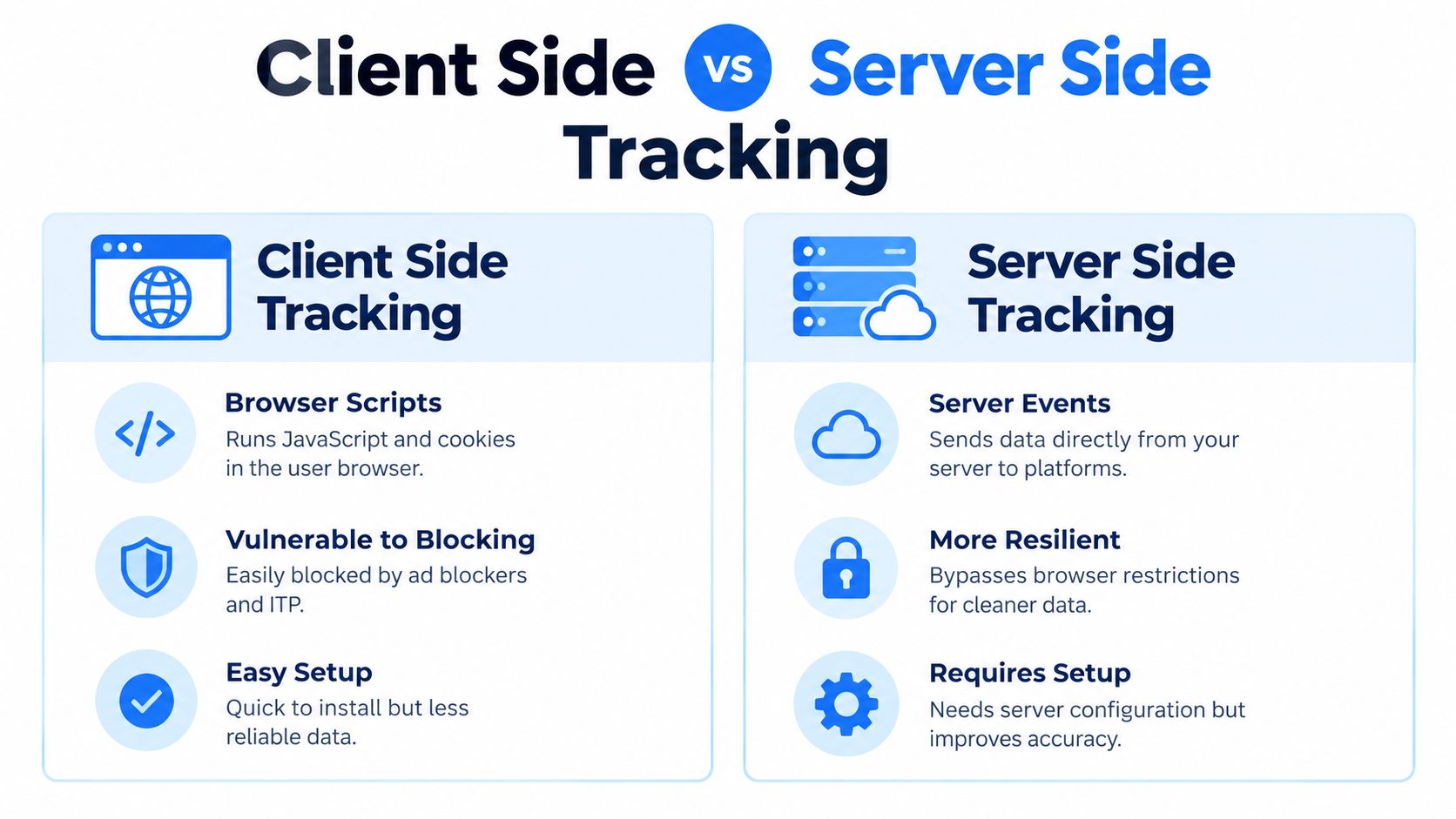
Most ad tracking setups use two collection paths. One happens in the visitor's browser. The other happens through your server or a first-party collection endpoint.
They work differently, and they fail differently.
### Client-side tracking in plain English
Client-side tracking is the traditional version. A script runs in the browser, often through a pixel or tag. It can read page activity, set cookies, and send events to platforms like Google Ads, Meta, or GA4.
That approach is easy to install, but it's directly exposed to browser controls and blockers. A Usercentrics guide explains that browser-based trackers rely on cookies to re-identify devices and aggregate behavior, while server-side collection shifts handling to the advertiser's servers and can enrich events before forwarding them. See their overview of [server-side tracking and attribution](https://usercentrics.com/guides/server-side-tagging/server-side-tracking-attribution/).
### Server-side tracking in plain English
Server-side tracking moves event collection or forwarding away from the browser and into infrastructure you control more directly. A browser event may still happen first, but instead of every platform tag firing independently from the page, your site can send data to a first-party endpoint. That endpoint can then enrich and forward events to ad platforms and analytics tools.
For a local service business, that matters when someone starts on one device, books later, or completes part of the journey offline. Server-side pipelines can improve click-to-conversion matching and reduce losses that happen before a browser pixel ever reaches the ad platform.
A deeper walkthrough of the tradeoffs is in this guide on [server-side vs client-side tracking](https://benjiads.com/blog/server-side-vs-client-side).
Here's a short explainer if you want to see the mechanics visually.
### Client Side vs Server Side Tracking Compared
| Feature | Client Side Tracking | Server Side Tracking |
|---|---|---|
| Where it runs | In the user's browser | On your server or first-party endpoint |
| Main strength | Fast to deploy and widely supported | More resilient event delivery |
| Main weakness | Vulnerable to blockers, cookie loss, and browser limits | More setup work and more moving parts |
| Data flow | Each platform tag may fire separately | One collection point can forward to multiple tools |
| Best use | Basic page and conversion tracking | Durable conversion forwarding and data cleaning |
| Local business value | Easy start for forms and page actions | Better for bookings, offline outcomes, and cross-session matching |
> **Key distinction:** Server-side tracking can improve measurement quality, but it doesn't prove that an ad caused the sale.
That warning matters. Growth Marketer notes that attributed credit still isn't the same thing as causal impact. Better event capture can improve reporting and bidding, but teams still need holdout tests, geo tests, or lift studies to validate true business effect. Their article on [server-side tracking and attribution limits](https://growthmarketer.com/blog/server-side-tracking-attribution/) makes that point clearly.
## Key Integrations That Make Tracking Useful
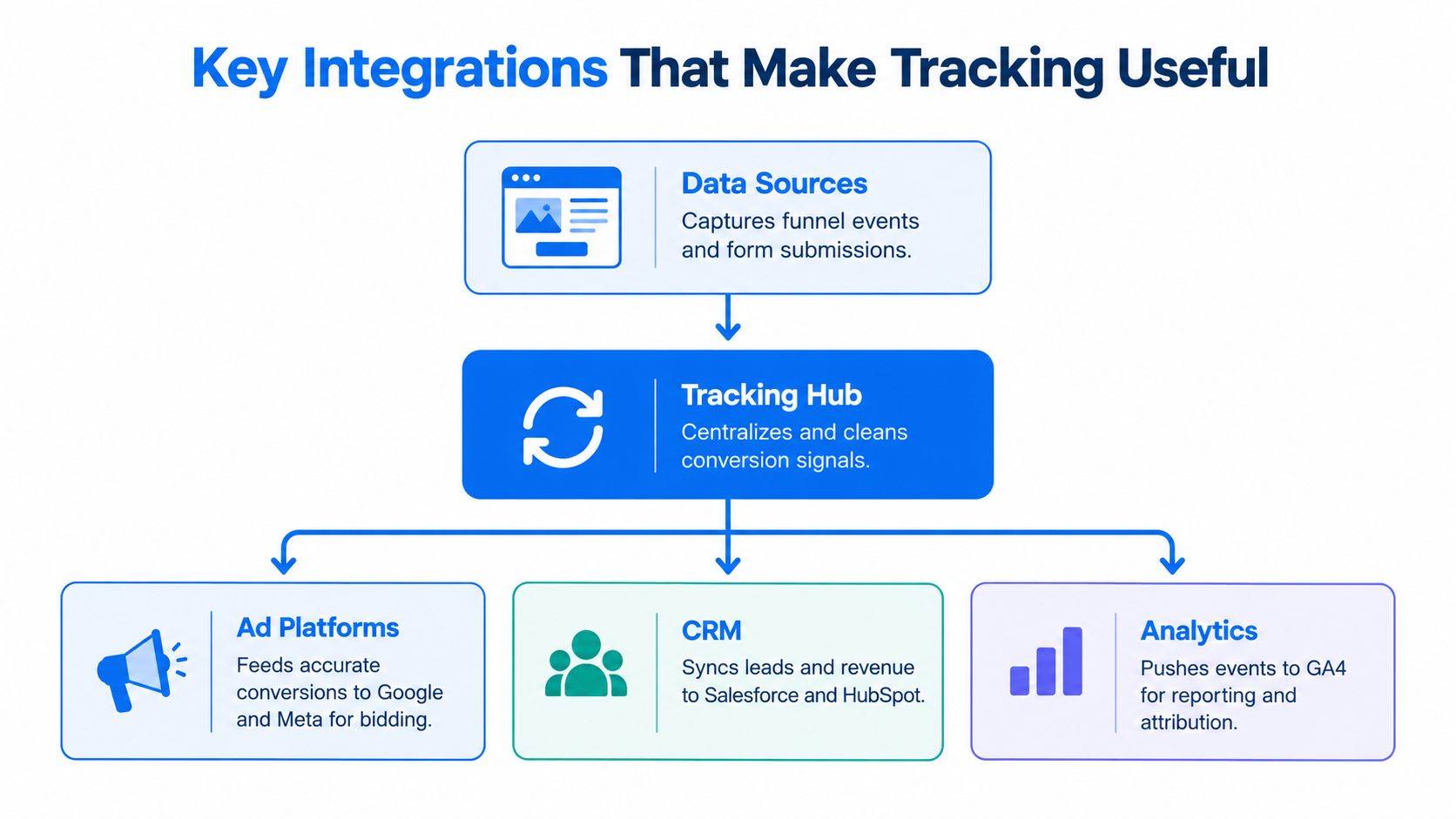
Tracking gets valuable when it leaves the website and connects to the systems that run your business.
A pixel alone can tell you that someone submitted a form. It usually can't tell you whether your team contacted that lead, whether the appointment was scheduled, or whether the job was worth pursuing. That's where integrations matter.
### The minimum useful flow
A practical setup often looks like this:
1. **Your landing page collects the event.** A visitor clicks an ad, browses a page, starts a form, or calls.
2. **A tracking hub receives the signal.** This may be a tag manager, a server endpoint, or a platform that handles both.
3. **The signal gets cleaned before forwarding.** Consent is checked, duplicate events are filtered, and identifiers are attached when allowed.
4. **Multiple tools receive the event.** Google Ads, Meta, GA4, and your CRM each get the version they need.
5. **Later outcomes come back.** Booked appointments, closed deals, or revenue are synced back into your reporting and ad platforms.
### The integrations that change decision quality
Not every connection matters equally. These usually do.
- **Ad platform integrations** matter because bidding systems learn from the conversion events you send them. If the signals are incomplete or duplicated, budget decisions drift.
- **CRM integration** matters because the website lead is only the beginning. Your CRM knows whether someone replied, scheduled, showed up, or bought.
- **Analytics integration** matters because you still need a broader view of pages, sessions, and channel paths.
- **Follow-up tool integration** matters because speed-to-contact affects whether a lead becomes real pipeline.
A lot of local businesses benefit from platforms that bundle several of these pieces together. For example, [automated marketing platform software](https://benjiads.com/blog/automated-marketing-platform) can combine ad launch, funnel tracking, and lead follow-up so the handoff doesn't break between systems.
### Two quiet problems that ruin reports
The least glamorous tracking work is often the most important.
| Problem | What happens if you ignore it |
|---|---|
| Deduplication | One booking gets counted multiple times across browser and server events |
| Consent filtering | Data gets collected or forwarded when it shouldn't, creating compliance and trust issues |
| Outcome syncing | Campaigns optimize to form fills instead of actual booked work |
| Identifier mismatch | Leads exist in one system but can't be tied back to the right campaign |
A lot of articles stop at "send more events server-side." That's incomplete. Signal Bridge Data points out that server-side collection can improve event capture, but it still doesn't solve the closed-loop problem by itself. The harder work is connecting that cleaner event flow to offline outcomes, consent handling, and platform-specific limits. Their discussion of the [server-side tracking benchmark problem](https://www.signalbridgedata.com/blog/server-side-tracking-benchmark-report-2026) is useful on that point.
## How Better Tracking Improves Campaign Optimization
Once your tracking is cleaner, your campaigns usually become easier to manage for one reason. You stop optimizing for the wrong event.
A local service business often starts by optimizing for form submissions because they're easy to measure. But not all forms are equal. Some are spam, some are price shoppers, and some never answer the phone. Better tracking lets you optimize toward actions that sit closer to revenue, such as verified leads, booked estimates, or completed appointments.
### What changes inside the ad platforms
When Google Ads or Meta receives stronger conversion signals, several parts of performance management get better.
#### Bidding becomes less blind
If the platform only sees top-of-funnel activity, it will chase more of that activity. If it starts receiving better downstream signals, bidding can shift toward people who are more likely to book.
#### Audience targeting gets sharper
You can build retargeting and lookalike-style strategies around higher-quality actions instead of simple page visits. That usually means less wasted reach.
#### Budget allocation gets simpler
When campaigns are compared on meaningful outcomes, it's easier to cut weak spend and protect strong spend. You spend less time arguing with conflicting dashboards and more time looking at whether leads turned into work.
### A local example
Take a cleaning company running two offers. One ad pushes a discount. Another promotes recurring service reliability.
The discount ad may generate more leads. The recurring-service ad may generate fewer leads but more booked customers who stick. If your tracking stops at the form fill, you'll probably scale the wrong one. If your tracking links the lead to the booked job and later revenue, your budget decision changes.
> Better tracking doesn't just improve reporting. It changes what the ad platforms learn from.
### What to watch in reports
For local businesses, useful reporting usually focuses on a short chain:
- **Cost per lead**
- **Lead quality**
- **Booked appointments**
- **Closed revenue**
Everything else supports those questions.
Some software stacks combine campaign launch, signal collection, and follow-up so those metrics stay tied together. One example is [Google Ads software for local businesses](https://benjiads.com/blog/google-ads-local), which can be paired with tracking and lead handling workflows instead of treating advertising and operations as separate systems. In the same category, benjiads is software that automates ads on Meta and Google, uses server- and client-side signals, and follows up with leads by text, which reflects this more integrated approach.
### The practical takeaway
Cleaner tracking helps in four ways:
- **You train platforms on better outcomes** instead of shallow conversions
- **You suppress waste faster** because weak traffic becomes easier to spot
- **You improve retargeting logic** by segmenting people based on real actions
- **You read results in business terms** rather than click metrics alone
For most owners, that's where ROI improves. Not from fancy attribution charts, but from using better signals to make better budget calls.
## Common Misconceptions About Attribution and Privacy
A lot of tracking advice sounds more certain than it should.
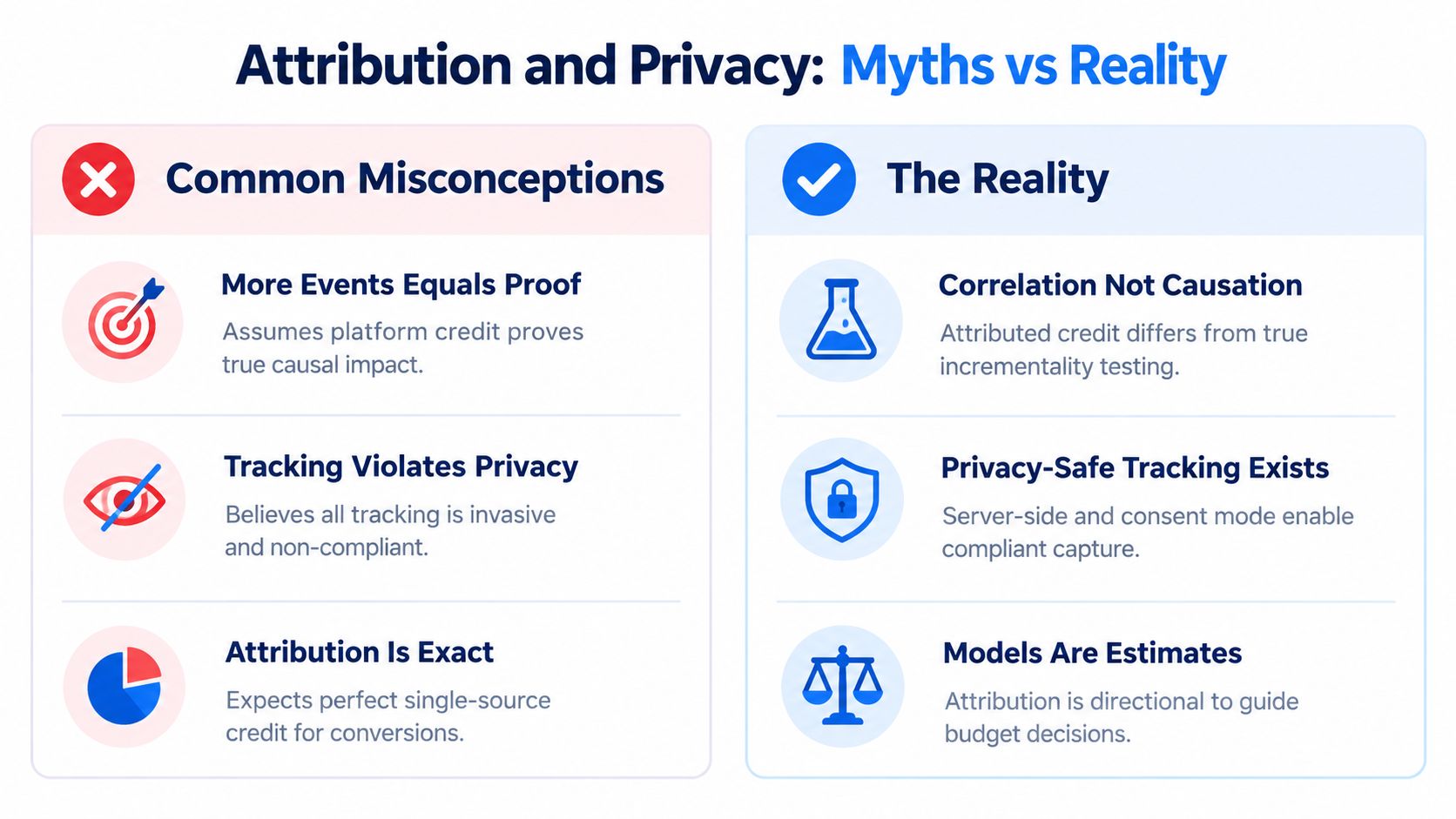
More captured events can improve visibility. They do **not** automatically create truth.
### Misconception one: if the platform got the conversion, the ad caused it
Attribution platforms assign credit based on rules. Incrementality asks a different question. Would the outcome have happened without the ad?
Those are not the same thing. A person may have searched for you anyway, returned directly later, or booked because of a referral after seeing your ad. The platform can still claim the conversion if its rules say the ad was eligible for credit.
That's why serious measurement still needs validation methods like holdout tests or geo tests.
### Misconception two: server-side tracking solves privacy and accuracy all by itself
It doesn't. Server-side transport can improve data delivery, but it still has to respect consent and lawful basis. If the consent logic is wrong, a cleaner pipeline just moves the wrong data more efficiently.
> Privacy-safe tracking isn't the absence of tracking. It's tracking with clear rules about what gets collected, when, and why.
### Misconception three: attribution will stay under your control
The market is shifting. Inside Telecom reports that the W3C-backed Attribution API is moving more measurement into browser and vendor infrastructure, using limited signals and aggregated reporting instead of raw user-level visibility. That raises a strategic question about [privacy-preserving attribution and platform-controlled reporting](https://insidetelecom.com/ad-attribution-tool-replace-raw-data-with-privacy-noise/).
For business owners, that means different systems may disagree more often:
- **The ad platform** may report one number
- **Your first-party tracking** may report another
- **Your CRM and booking system** may show something else
None of those views should be treated as perfect.
### A smarter way to think about truth
Attribution is best treated as a **decision aid**, not a courtroom verdict.
Use platform reports to guide bidding. Use first-party and server-side tracking to reduce signal loss. Use CRM and revenue data to close the loop. When results matter enough, validate with testing.
That mindset keeps you from overreacting to a single dashboard.
## Choosing and Getting Value From Ad Tracking Software
The right ad tracking software for a local business isn't the one with the longest feature list. It's the one that helps you make better decisions about spend, follow-up, and bookings.
A strong setup usually checks five boxes.
### What to look for first
#### It combines browser and server signals
You don't want a setup that depends on only one collection method. Browser events are still useful. Server-side forwarding adds resilience.
#### It connects to your actual funnel
If the software tracks clicks but doesn't connect to forms, phone leads, appointment scheduling, or CRM stages, you'll still lose the story halfway through.
#### It handles consent and deduplication
These are not side issues. If the system double counts or ignores consent logic, the reports become less trustworthy.
### What to look for next
- **Offline outcome linking** so leads can be tied to bookings and revenue later
- **Clear reporting** focused on leads, booked jobs, and cost efficiency
- **Integrations with Google Ads, Meta, analytics, and CRM tools**
- **Practical setup requirements** that your team can maintain
### A simple buying question
Before you choose any platform, ask this:
> Can this system show me which campaigns produced booked business, not just which campaigns produced clicks or form fills?
If the answer is fuzzy, keep looking.
The reason this matters is simple. The value of ad tracking software isn't in the tracking alone. It's in the decisions that become possible when your click data, follow-up data, and revenue data finally line up closely enough to act on.
For a busy owner, that usually means choosing software that reduces handoffs, keeps the signal clean, and reports performance in plain language instead of analytics jargon.
---
If you want a simpler way to put this into practice, [benjiads](https://benjiads.com) combines ad creation, Meta and Google campaign launch, server- and client-side tracking, and automated text follow-up for local service businesses. It's built to connect clicks to leads and bookings in one approval-first workflow, so you can spend less time stitching tools together and more time seeing what your ads produce.